

Before 1911, a broken arm on the job could mean financial ruin. No guaranteed payout, no medical coverage, no fallback. Just a worker, a courtroom, and an employer with three ironclad legal defenses ready to go. That’s the world workers’ compensation was born to fix, and the story of how it got built is one of the most consequential policy shifts in American history.
A System Born From Disaster
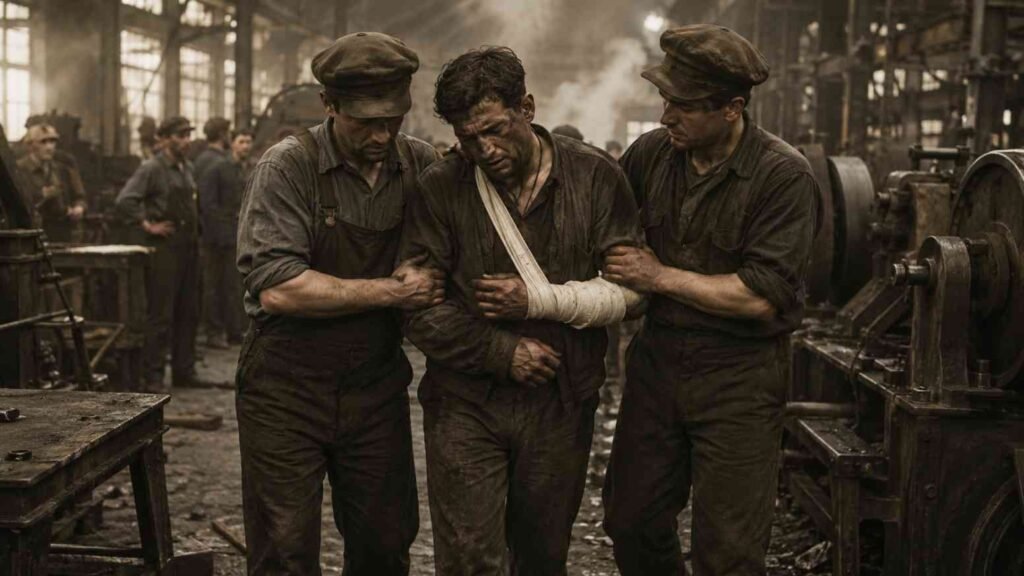
The 19th century American workplace was brutal by any modern measure. Factories, mines, and railroads were mechanizing rapidly, and injury rates climbed with every passing decade. The legal framework at the time gave injured workers one option: sue. But winning in court was nearly impossible.
Employers relied on three common law defenses. The fellow servant rule said the employer bore no responsibility if a coworker caused the injury.
Contributory negligence meant a worker who was even slightly at fault recovered nothing. And the assumption of risk doctrine held that workers voluntarily accepted danger when they accepted the job. Taken together, these three doctrines made litigation a dead end for most injured employees.
Europe moved first. Germany under Chancellor Otto von Bismarck introduced sickness and accident insurance laws in the 1880s, creating what historians generally recognize as the template for modern workers’ compensation. Britain followed with its own Workmen’s Compensation Act. American policymakers noticed, and by the early 1900s, pressure was building on state legislatures to act.
“Workers’ compensation was the first form of social insurance to develop widely in the United States,” according to the Social Security Administration’s historical overview of the program, which traces the system’s roots to a period when the federal government treated workplace safety as a matter for individual states to resolve.
The federal government was actually the first to establish a workers’ compensation program, covering its civilian employees with an act passed in 1908 to provide benefits for workers engaged in hazardous work , according to the Social Security Administration’s background review of workers’ compensation (SSA, 2002. State systems followed within a few years.
The Grand Bargain: Why Everyone Said Yes

What made workers’ compensation spread so quickly across states after 1911 is a question worth sitting with. The answer lies in what you might call the Industrial Bargain Framework, a three-sided trade-off that gave every major stakeholder a reason to agree.
Workers gave up the right to sue their employers in civil court for negligence. That sounds like a loss, but in practice, civil suits almost never succeeded, so there was little to give up. What workers gained was something far more valuable: a guaranteed, no-fault path to medical care and partial wage replacement.
Employers gained cost predictability. Instead of facing potentially enormous jury verdicts, they paid fixed insurance premiums and knew exactly what their liability exposure looked like at the start of every year. That kind of certainty was enormously appealing to the business community.
Managing predictable financial obligations remains important for businesses and households alike, particularly when considering tax-saving moves from financial experts.
States got social stability. A workforce that couldn’t afford an injury and had no safety net was a workforce one disaster away from radicalization. Workers’ comp drained some of the pressure that was building in American labor politics during the Progressive Era.
Wisconsin enacted the first comprehensive state law in 1911. Nine other states passed their own versions that same year. Workers’ compensation laws were originally adopted by most states between 1911 and 1920, and the programs continue to be administered by state governments today. Mississippi was the final holdout, adopting its system in 1948.
What the Numbers Tell You About Why It Matters
Here’s a useful way to understand what the reformers were actually trying to solve. Imagine a miner named Tom Briggs working a Colorado silver operation in 1912. He’s 34, supports a wife and three children on a dollar-a-day wage, and loses two fingers in a drilling accident.
Under the old system, Tom hires a lawyer, waits three years for a trial date, and almost certainly loses. Under the new workers’ comp framework, Tom files a claim, gets his medical bills covered, and receives a weekly benefit while he recovers. Same injury, two completely different outcomes.
That difference also highlights why having a strong and sustainable wealth strategy can matter when an unexpected injury affects a household’s income and financial stability. That gap is what drove reformers to push so hard, so fast.
The scale of the underlying problem has never gone away. A total of 5,070 workers died from on-the-job injuries in the United States in 2024, a 4.0-percent drop from the 5,283 recorded in 2023 , and private industry employers reported 2.5 million nonfatal workplace injuries and illnesses in 2024, down 3.1 percent from 2023 , according to the U.S. Bureau of Labor Statistics (BLS, 2026).
Even with a century of safety improvements, the numbers make clear why the compensation framework built in the 1910s still matters every single workday.
| Year / Period | Milestone
|
|---|---|
| 1871 | Germany passes first modern workers’ compensation laws under Bismarck |
| 1897 | Britain enacts Workmen’s Compensation Act, eliminating fault requirement |
| 1908 | U.S. federal government covers hazardous civilian workers for the first time |
| 1911 | Wisconsin passes first comprehensive state law; nine states follow that year |
| 1911–1920 | Majority of U.S. states adopt workers’ compensation systems |
| 1917 | U.S. Supreme Court rules states may require mandatory participation |
| 1948 | Mississippi becomes the last state to adopt a workers’ comp system |
| 2024 | 2.5 million nonfatal workplace injuries reported nationally (BLS) |
How State Systems Developed Their Own Character
Because workers’ compensation was always a state-level project, every state built something slightly different. Benefit formulas vary. The list of covered conditions varies.
Deadlines for filing claims vary. The role of the courts versus administrative agencies varies. What looks simple in concept turns out to be a patchwork of rules that can trip up anyone who doesn’t know the specific system in their state.
The modern system of workers’ compensation is so complex and arcane it produces considerable grief to those who must deal with it on a daily basis, yet these often cumbersome regulations are ultimately vital to society and appear in one form or another in all industrialized nations , as noted in a peer-reviewed history published in the Iowa Orthopaedic Journal via the National Institutes of Health.
That complexity is part of why injured workers so often need guidance specific to their own state’s rules.
Colorado, for example, built a system that covers most private-sector workers and requires employers to carry insurance or qualify as self-insured. Understanding the deadlines, the benefit tiers, and the dispute resolution process under a specific state system is genuinely different from understanding the general concept.
Anyone navigating a claim under colorado workers compensation rules is dealing with a body of law that has its own procedural requirements and administrative agencies, and the details matter far more than the broad principles.
What the History Should Tell You Today
The reformers of 1911 built a system to solve a specific failure: injured workers with no realistic path to compensation, and employers facing unpredictable and often ruinous litigation.
More than a century later, the underlying structure they created is still standing, because the Industrial Bargain Framework solved a real problem well enough that nobody found a reason to tear it down entirely.
What has changed is the complexity layered on top. Benefit rates, medical provider rules, appeal timelines, and return-to-work requirements have all grown more detailed over the decades.
That’s where the gap opens between understanding the system in the abstract and knowing how it actually works in your state and your situation.
The century-long arc of workers’ compensation reform is, at its core, a story about closing the distance between a serious workplace injury and a fair outcome. That work is still ongoing. And if the history of the system tells you anything useful, it’s that the details of where you are and when you file matter just as much as the principle that you’re owed something when you get hurt on the job.